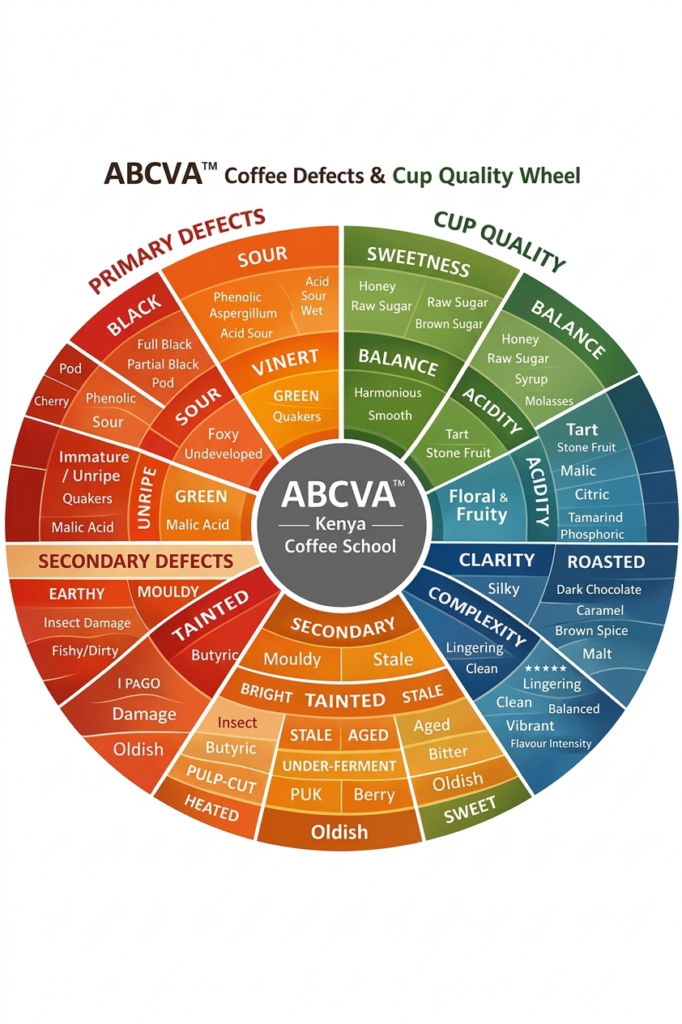
Interpreting a flavor wheel like the ABCVA™ Coffee Defects & Cup Quality Wheel is all about moving from the general to the specific. It is designed to be read from the center outward to help you categorize what you are tasting.
Here is how to navigate it:
- The Big Split: Left vs. Right
The wheel is divided into two main hemispheres to help you decide the “health” of the coffee immediately:
- Left Side (Warm Colors/Reds/Oranges): Focuses on Defects. These are the “negatives”—flavors that indicate poor processing, storage issues, or agricultural problems.
- Right Side (Cool Colors/Greens/Blues): Focuses on Cup Quality. These are the “positives”—the attributes you look for in specialty coffee, such as sweetness, acidity, and complexity.
- Navigating the Rings
The wheel uses a hierarchical structure. To identify a flavor or defect, follow these steps:
- Start at the Center (Inner Ring): Identify the broad category.
- Example: You taste something unpleasant. You look at the left and decide it’s a Primary Defect.
- Move to the Middle Ring: Narrow it down.
- Example: Within Primary Defects, does it taste Sour or like a Black (over-fermented) bean?
- Land on the Outer Ring: This is the specific descriptor.
- Example: If it was Sour, is it Phenolic (chemical/medicinal) or Aspergillus (moldy/earthy)?
- Interpreting Specific Sections
Primary & Secondary Defects
- Primary: These are “major” faults (like Full Black or Sour) that can ruin an entire batch even in small quantities. They usually point to issues during the harvest or drying phase.
- Secondary: These are “minor” faults (like Insect Damage or Pulp-Cut). They affect quality but are often less aggressive than primary defects.
Cup Quality - Acidity: Look for the specific type. Is it Citric (lemon-like), Malic (apple-like), or Phosphoric (sparkling/soda-like)?
- Complexity & Clarity: This describes how many layers the coffee has. A Silky clarity means the coffee is clean and easy to distinguish, while Complexity suggests many flavors hitting at once.
- Roasted: This refers to the development of the bean. You want to see notes like Dark Chocolate or Brown Spice rather than “ashy” or “burnt” notes.
- How to Use It During a Tasting
- Take a sip (Slurp): Spread the coffee across your palate to aerate it.
- Look for a “Region”: Don’t look for the word “Tamarind” immediately. Look at the colors. Does it feel “Blue” (Complexity/Roasted) or “Green” (Sweetness/Balance)?
- Refine: Once you are in the right color zone, read the words until one “clicks” with what you are experiencing.
#Kenya Coffee School #Barista Mtaani