Kenya Coffee School (KCS)
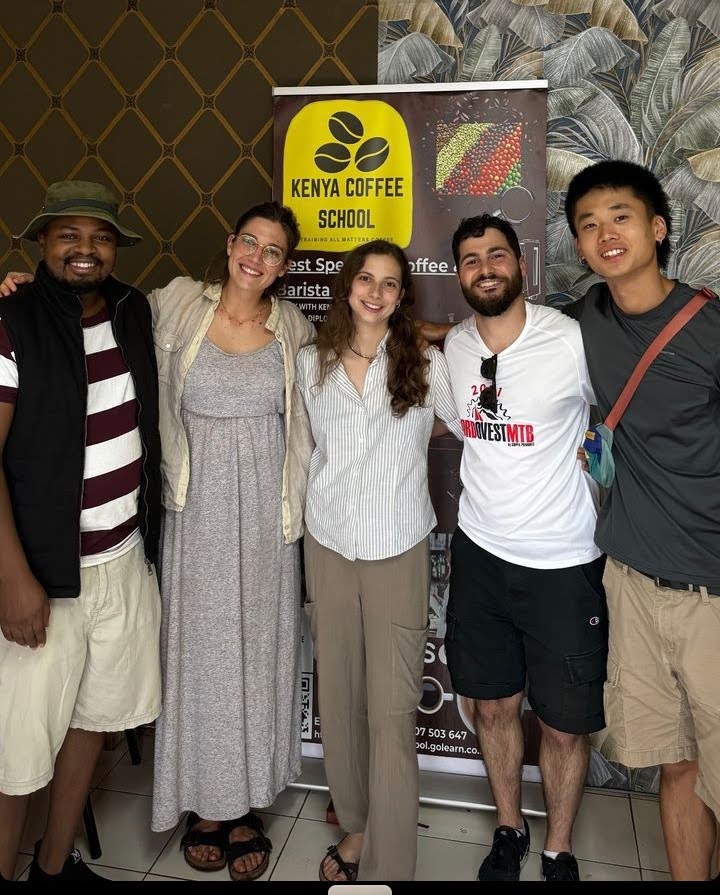
Welcome to Kenya Coffee School
Kenya Coffee School : Sustainable Knowledge for Every Stage of Your Barista and Specialty Coffee Career
Kenya Coffee School Training Levels : Certificate / Diploma / Advanced Diploma / Micro-Masters / Coffee MBA
The KCS’s Diploma Coffee Skills Program consists of education in the following specialties within the coffee industry:
- Introduction to Specialty Coffee Processing & Coffee Farming
- Barista Skills – Latte art / International Recipes
- Coffee Brewing Module
- Green Coffee Module
- Sustainable Coffee Management
- Coffee Sensory Skills / Grading / Cupping
- Coffee Roasting Education
- Coffee Machinery Technology
- Coffee Chemistry
- Soil Analysis / Regenerative Coffee /Biodiversity
- Vertical Coffee Value Chains / Applied Sciences
- Climate Change / Circular Economy in Coffee
- Coffee Apprenticeship / Entrepreneurship / Customer service
- Mixology / Bartender Courses / Tea and Kombucha
- Gastronomic Sciences and Coffee Health Sciences
- GIS Technology and Mapping Traceability in Coffee
- Specialty Coffee Micro Biology, Botany and Physics
- Coffee Trade Certification Registration / Requirements and Compliance e.g. G4T, EUDR and Others
- Pastry, Gelato Ice creams, Chocolates and Coffee Confectionery
- KCS Coffee Branding and Sales & Marketing
- Coffee Innovation and Innovative Management Systems (IMS)
- POS / CRM / BI / ERPs for HORECA Systems
- Digital Inclusivity and Life Skills for Youth in Coffee
- HACCP Education Food Handlers Training
- First Aid Education & Coffee Safety in work places
- Sustainable Coffee Supply Chain Management Education
- Good Factory Management Practices, Governance in Coffee Cooperatives of the Quality Infrastructure in the context of a Quality Policy and a sustainability strategy
- Fundamentals of Sustainable Coffee Trade and Logistics in the age of Digital Information
- Coffee and Storytelling Education
- Coffee Logistics Module (Import / Export) / Direct Trade of Green and Roasted Coffee
- Film Making and Coffee Aromatic Linguistics & Expressions Module
- Coffee Livelihoods, SDGs and Community Development Education
- Coffee and Bees / Honey Production and Apitherapy
- Digital Coffee Skills for the Youth : Cyber Security, AI, IOT, and Blockchain Technologies
- Kenya Coffee School Business and Policy Law Studies
- The Art of Coffee International Negotiations
- Implementing a Coordinated Criminal Justice Response to Gender-based Violence Against Women Course (Women in Coffee Equality)
- Good Trade Certification (G4T) Studies – Beyond Fairness
- Coffee Livelihoods in Community Development
- Certificate (3 months) and Diploma (5 months) in Events Management, Hospitality Management and Gastronomy
Together these modules of learning are known as the KCS Skills Program. Students can take advantage of learning through three stages of knowledge and skills in each module: Foundation, Intermediate and Professional Coffee Skills.
Modules and Levels
The KCS Coffee Skills Program consists of six different modules: Introduction to Coffee, which is available at one level, and five specialist modules; Barista Skills, Brewing, Green Coffee, Roasting and Sensory Skills,
Each of the specialist modules is available at three different levels, with points attached at every stage. You may choose the modules that fit your interests and needs. Once you have achieved 100 points, you will be awarded the KCS Coffee Skills Diploma certified by Kenya Coffee School Lavazza Certified Trainer.
KCS has 12 Modules + 3 Mandatory Extra Courses as outlined above
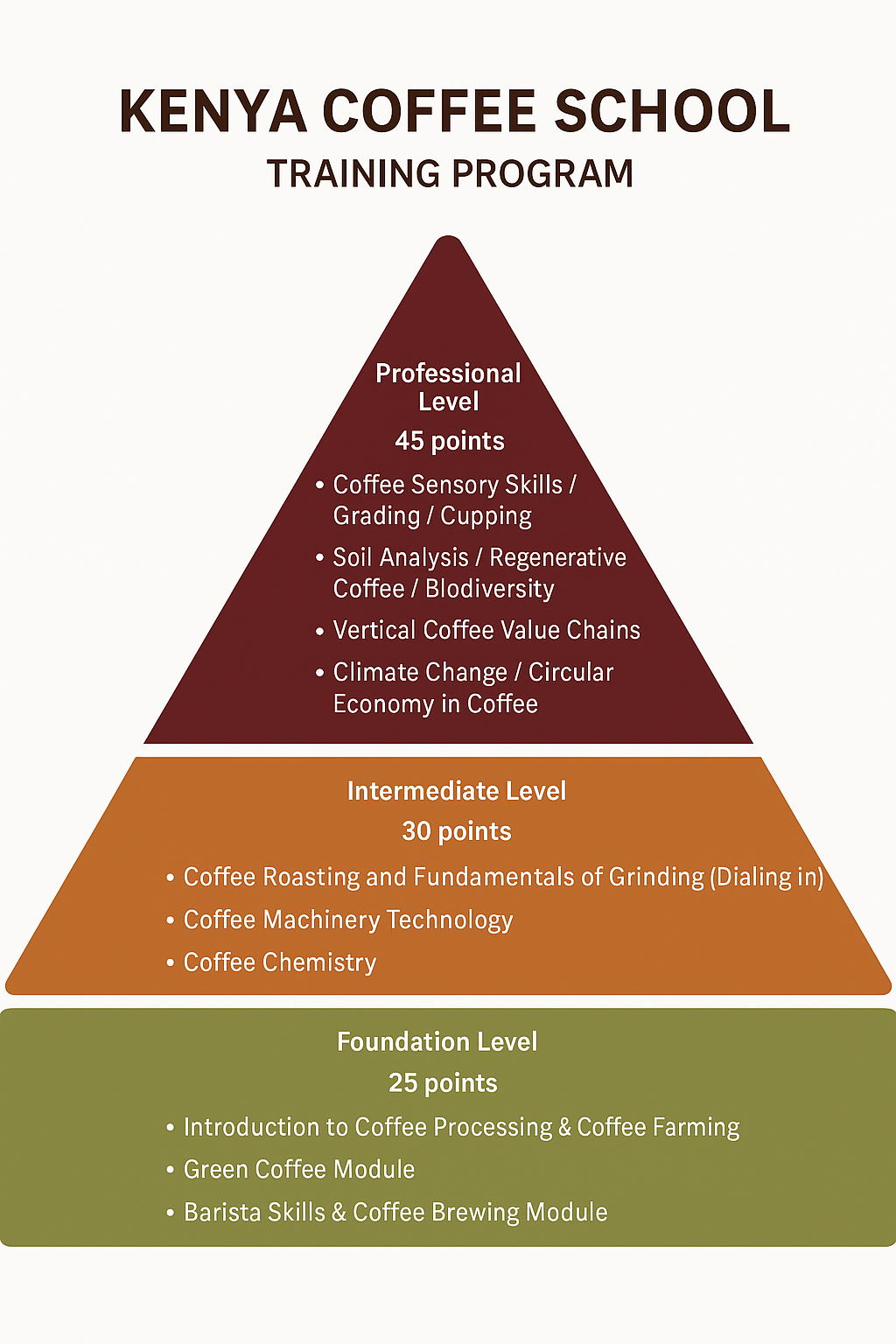
KCS have 3 Main Category Levels of Studies :
KCS Foundation Level: 25 Points
KCS Intermediate Level: 30 Points
KCS Professional Level: 45 Points
Enroll Today :
COOPERATIVE BANK : MPESA PAYBILL : 400200
ACCOUNT : 842788
RECEIVED BY ACCOUNT NAME : KENYA COFFEE SCHOOL
*Specialty Coffee Diploma costs : Ksh.47,000/- + : *Certificate Level : 34,500/- *KCS *Mixology / Bartender : 32,500/-
(Duration of Study 4 to 8 Weeks)
Maps Generator
Important News Around Coffee and Coffee Events
Find Us Via Map : Directions
Follow Kenya Coffee School on Instagram
KENYA COFFEE SCHOOL™
Digital Badges & Certificates Verification System
☕ Kenya Coffee School – the leading institution for Barista Skills, Specialty Coffee, and Mixology Training in Kenya. We offer internationally recognized programs designed to equip you with world-class coffee and beverage expertise.
🎓 Courses & Fees
Barista and Specialty Coffee
Barista & Specialty Coffee Certificate Level (Barista Mtaani) — KES 34,500 (4 Weeks)
Specialty Coffee Foundation Diploma Level — KES 47,500 (5–6 weeks)
Specialty Coffee Intermediate Diploma Level — KES 64,300 (8–9 weeks)
Specialty Coffee Professional Diploma Level — KES 89,700 (11–12 weeks)
Mixology / Bartender : KES 37,500/-
🍹 Combined Offer
Barista Skills + Specialty Coffee + Mixology — KES 67,500
💰 All fees payable in installments and inclusive of exams and certification.
🌱 Advanced Coffee #Courses / Micro Masters Level
Coffee Value Analysis (CVA) — KES 78,900 (2 weeks)
KCS-ABC™ Coffee Grading (Equivalent to Q Grading) — KES 84,200 (3 weeks)
KCS Coffee Micro-Masters Level 12 Months – Request for a Quote
Share Your Achievement!
Celebrate your success by sharing your verified credentials.