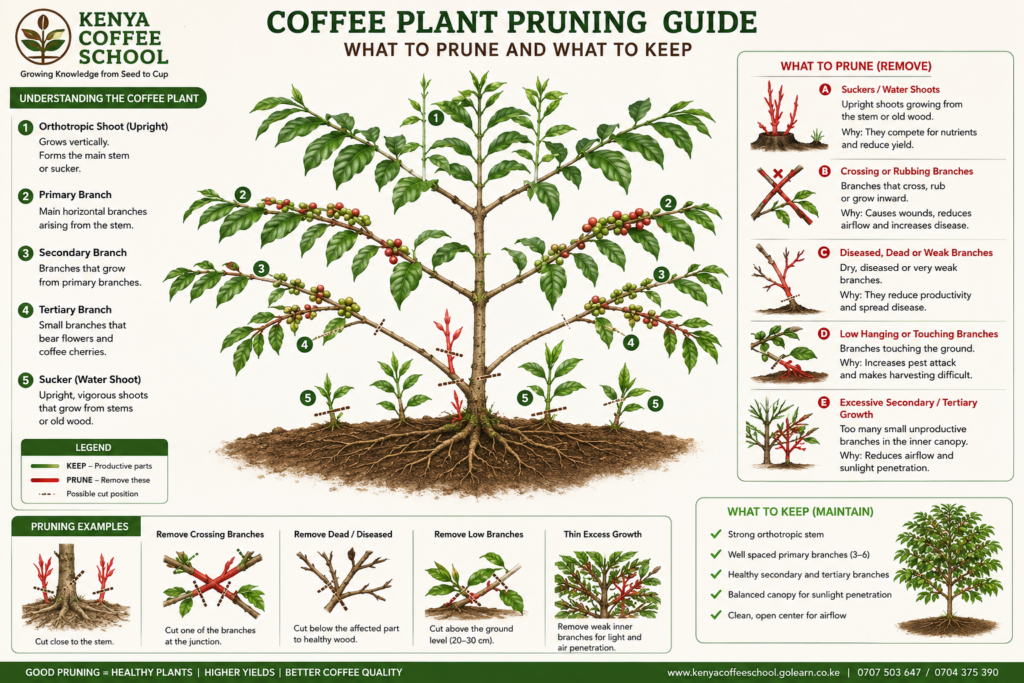
Orthotropic and Plagiotropic Growth in Coffee Plants and Pruning Relevance
Understanding Coffee Plant Architecture for Better Productivity
By Kenya Coffee School
Coffee is a unique perennial crop because it exhibits dimorphic growth, meaning it develops two distinct types of shoots: orthotropic and plagiotropic. Understanding these growth habits is essential for coffee farmers, nursery managers, baristas seeking deeper coffee knowledge, and anyone involved in specialty coffee production. Proper management of these growth forms directly influences yield, plant health, pruning decisions, and long-term productivity.
Orthotropic Growth
Orthotropic growth refers to the upright, vertical stem of the coffee tree. This is the main trunk that grows toward the sky and provides the structural framework of the plant.
Characteristics
- Grows vertically.
- Forms the main stem or trunk.
- Produces new nodes from which lateral branches emerge.
- Can produce new upright suckers after pruning.
- Responsible for increasing the height and structural strength of the coffee tree.
Orthotropic stems are particularly important during rejuvenation. After stumping or severe pruning, new orthotropic shoots replace old stems and restore the productivity of the coffee plant. Research has shown that management practices such as pruning or apical manipulation can stimulate the emergence of vigorous orthotropic shoots.
Plagiotropic Growth
Plagiotropic growth refers to the horizontal or nearly horizontal lateral branches that emerge from the orthotropic stem.
Characteristics
- Grow sideways.
- Carry leaves, flowers, and coffee cherries.
- Produce secondary lateral branches.
- Determine the productive canopy of the coffee tree.
- Most coffee harvesting takes place from these branches.
Unlike orthotropic shoots, plagiotropic branches are specialized for fruit production rather than vertical growth.
Key Differences
| Orthotropic Growth | Plagiotropic Growth |
|---|---|
| Vertical | Horizontal |
| Forms the trunk | Forms lateral branches |
| Structural support | Fruit production |
| Produces suckers | Produces flowers and cherries |
| Used for rejuvenation | Main harvesting branches |
Why Farmers Should Understand the Difference
Recognizing these two growth habits helps farmers to:
- Prune correctly without removing productive branches unnecessarily.
- Select the right shoots for rejuvenation.
- Improve sunlight penetration and airflow.
- Increase productivity and extend the economic lifespan of coffee trees.
- Produce healthier and more uniform coffee plantations.
Relevance in Coffee Education
At Kenya Coffee School, understanding coffee plant architecture forms part of the Farm-to-Cup Curriculum. Students learn how plant physiology influences:
- Coffee agronomy
- Nursery management
- Pruning systems
- Coffee physiology
- Yield optimization
- Sustainable coffee production
- Climate-smart coffee farming
By understanding the relationship between orthotropic and plagiotropic growth, coffee professionals can make better agronomic decisions that improve both quality and productivity.
Conclusion
A healthy coffee tree depends on the balance between strong orthotropic stems, which provide structure and renewal, and productive plagiotropic branches, which bear the coffee crop. Mastering this concept is one of the foundations of modern coffee agronomy and sustainable coffee production.