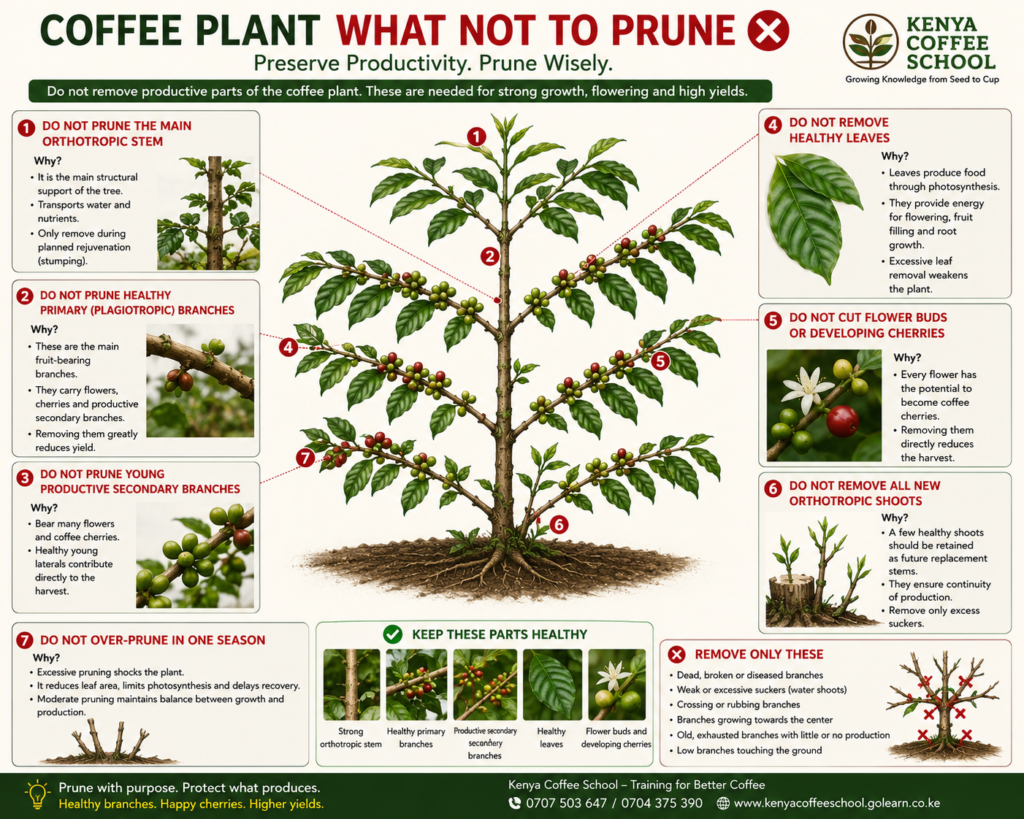
What Not to Prune on a Coffee Plant—and Why
Kenya Coffee School | Farm-to-Cup Agronomy Series
Pruning improves coffee productivity, but removing the wrong parts of the plant can reduce yields, delay production, and weaken the tree. The goal is to remove unproductive growth while preserving the branches that produce coffee cherries.
1. Do Not Prune Healthy Primary (Plagiotropic) Branches
Why?
- These are the main fruit-bearing branches.
- They carry flowers, cherries, and productive secondary branches.
- Removing them significantly reduces the next harvest.
2. Do Not Remove the Main Orthotropic Stem (Unless Rejuvenating)
Why?
- The orthotropic stem is the structural backbone of the coffee tree.
- It supports the canopy and transports water and nutrients.
- Only remove it during planned rejuvenation (stumping) when replacing an old or diseased stem.
3. Do Not Prune Young Productive Secondary Branches
Why?
- Secondary branches bear many flower buds and coffee cherries.
- Healthy young laterals contribute directly to yield.
- Only remove secondary branches that are dead, diseased, overcrowded, or no longer productive.
4. Do Not Remove Healthy Leaves
Why?
- Leaves produce food through photosynthesis.
- They provide energy for flowering, fruit filling, and root growth.
- Excessive leaf removal weakens the plant and lowers production.
5. Do Not Cut Flower Buds or Developing Cherries
Why?
- Every flower has the potential to become coffee cherries.
- Removing them directly reduces the harvest.
6. Do Not Remove All New Orthotropic Shoots
Why?
- A few healthy shoots should be retained as future replacement stems.
- They ensure continuity of production as older stems age.
- Remove only excess suckers that compete for nutrients.
7. Do Not Over-Prune in One Season
Why?
- Excessive pruning shocks the plant.
- It reduces leaf area, limits photosynthesis, and delays recovery.
- Moderate annual pruning maintains a balance between growth and production.
Keep These Parts Healthy
✅ Strong orthotropic stem (or selected replacement stems)
✅ Healthy primary (plagiotropic) branches
✅ Vigorous secondary fruiting branches
✅ Healthy green leaves
✅ Flower buds and developing cherries
Remove Only These
- Dead, broken, or diseased branches.
- Weak or excessive suckers (water shoots).
- Crossing or rubbing branches.
- Branches growing toward the center of the canopy.
- Old, exhausted branches with little or no production.
- Low branches touching the ground.
Kenya Coffee School Pruning Principle
“Never prune a branch simply because it exists. Prune because it no longer contributes to the health, structure, or productivity of the coffee tree.”
Proper pruning preserves the coffee tree’s productive framework while improving light penetration, air circulation, and long-term yield. A well-pruned coffee tree is balanced: it has a strong upright stem, well-spaced primary branches, productive secondary branches, and enough healthy leaves to sustain vigorous growth and high-quality coffee production.