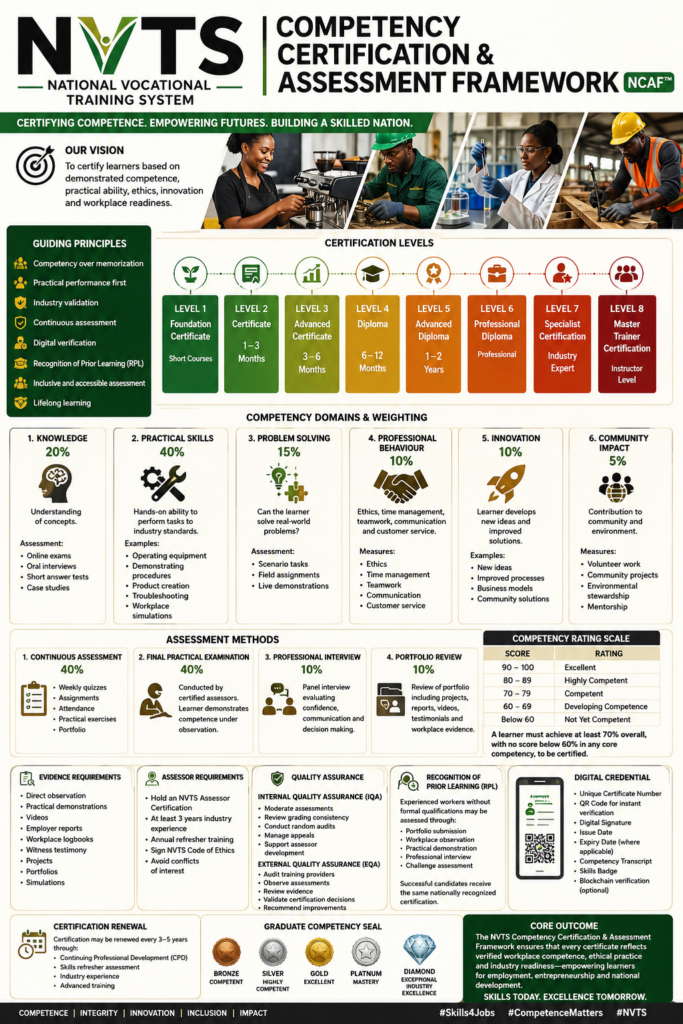
NVTS Competency Certification & Assessment Framework (NCAF™)
Version 1.0
Vision
To certify learners based on demonstrated competence, practical ability, ethics, innovation, and workplace readiness.
Guiding Principles
- Competency over memorization
- Practical performance first
- Industry validation
- Continuous assessment
- Digital verification
- Recognition of Prior Learning (RPL)
- Inclusive and accessible assessment
- Lifelong learning
Certification Levels
| Level | Qualification | Typical Duration |
|---|---|---|
| Level 1 | Foundation Certificate | Short Courses |
| Level 2 | Certificate | 1–3 Months |
| Level 3 | Advanced Certificate | 3–6 Months |
| Level 4 | Diploma | 6–12 Months |
| Level 5 | Advanced Diploma | 1–2 Years |
| Level 6 | Professional Diploma | Professional |
| Level 7 | Specialist Certification | Industry Expert |
| Level 8 | Master Trainer Certification | Instructor Level |
Competency Domains
Every learner is assessed in multiple domains.
1. Knowledge (20%)
Understanding of concepts.
Assessment
- Online exams
- Oral interviews
- Short answer tests
- Case studies
2. Practical Skills (40%)
The largest assessment component.
Examples
- Operating equipment
- Demonstrating procedures
- Product creation
- Troubleshooting
- Workplace simulations
3. Problem Solving (15%)
Can the learner solve real-world problems?
Assessment
- Scenario tasks
- Field assignments
- Live demonstrations
4. Professional Behaviour (10%)
Measures
- Ethics
- Time management
- Teamwork
- Communication
- Customer service
5. Innovation (10%)
Learner develops
- New ideas
- Improved processes
- Business models
- Community solutions
6. Community Impact (5%)
Measures
- Volunteer work
- Community projects
- Environmental stewardship
- Mentorship
Assessment Methods
Continuous Assessment (40%)
Includes
- Weekly quizzes
- Assignments
- Attendance
- Practical exercises
- Portfolio
Final Practical Examination (40%)
Conducted by certified assessors.
Learner demonstrates competence under observation.
Professional Interview (10%)
Panel interview.
Evaluates
- Confidence
- Communication
- Decision making
Portfolio Review (10%)
Portfolio may include
- Photos
- Videos
- Project reports
- Customer testimonials
- Supervisor reports
- Reflective journal
Competency Rating Scale
| Score | Rating |
|---|---|
| 90–100 | Excellent |
| 80–89 | Highly Competent |
| 70–79 | Competent |
| 60–69 | Developing Competence |
| Below 60 | Not Yet Competent |
A learner must achieve at least 70% overall, with no score below 60% in any core competency, to be certified.
Evidence Requirements
Certification decisions are based on evidence.
Acceptable evidence includes
- Direct observation
- Practical demonstrations
- Videos
- Employer reports
- Workplace logbooks
- Witness testimony
- Projects
- Portfolios
- Simulations
Assessor Requirements
Assessors should
- Hold an NVTS Assessor Certification
- Have at least three years of industry experience
- Complete annual refresher training
- Sign the NVTS Code of Ethics
- Avoid conflicts of interest
Internal Quality Assurance (IQA)
Responsibilities include
- Moderating assessments
- Reviewing grading consistency
- Conducting random audits
- Managing appeals
- Supporting assessor development
External Quality Assurance (EQA)
Independent external verifiers should
- Audit training providers
- Observe assessments
- Review evidence
- Validate certification decisions
- Recommend improvements
Digital Credential System
Each certificate should include
- Unique Certificate Number
- QR Code for instant verification
- Digital Signature
- Certificate Issue Date
- Expiry Date (where applicable)
- Competency Transcript
- Skills Badge
- Blockchain verification (optional)
Competency Transcript
Each graduate receives a transcript showing competency by skill area.
Example:
| Competency | Score |
|---|---|
| Technical Skills | 92 |
| Safety | 88 |
| Communication | 84 |
| Customer Service | 95 |
| Innovation | 86 |
| Leadership | 83 |
Recognition of Prior Learning (RPL)
Experienced workers without formal qualifications may be assessed through:
- Portfolio submission
- Workplace observation
- Practical demonstration
- Professional interview
- Challenge assessment
Successful candidates receive the same nationally recognized certification.
Certification Renewal
For rapidly evolving occupations, certification may be renewed every 3–5 years through:
- Continuing Professional Development (CPD)
- Skills refresher assessment
- Industry experience
- Advanced training
Graduate Competency Seal
Certified graduates earn one of the following seals:
- Bronze Seal – Competent
- Silver Seal – Highly Competent
- Gold Seal – Excellent
- Platinum Seal – Mastery
- Diamond Seal – Exceptional Industry Excellence
Core Outcome
The NVTS Competency Certification & Assessment Framework ensures that every certificate reflects verified workplace competence, ethical practice, and industry readiness. By combining continuous assessment, practical examinations, professional conduct, innovation, and quality assurance, NVTS certification becomes a trusted indicator that a graduate can perform effectively in real-world employment or entrepreneurship. This framework is flexible enough to support diverse vocational fields—including hospitality, coffee, agriculture, construction, ICT, healthcare, manufacturing, and creative industries—while maintaining a consistent national standard for competence.